What Makes a Good Montessori School in Bangalore? 7 Signs Every Parent Should Know
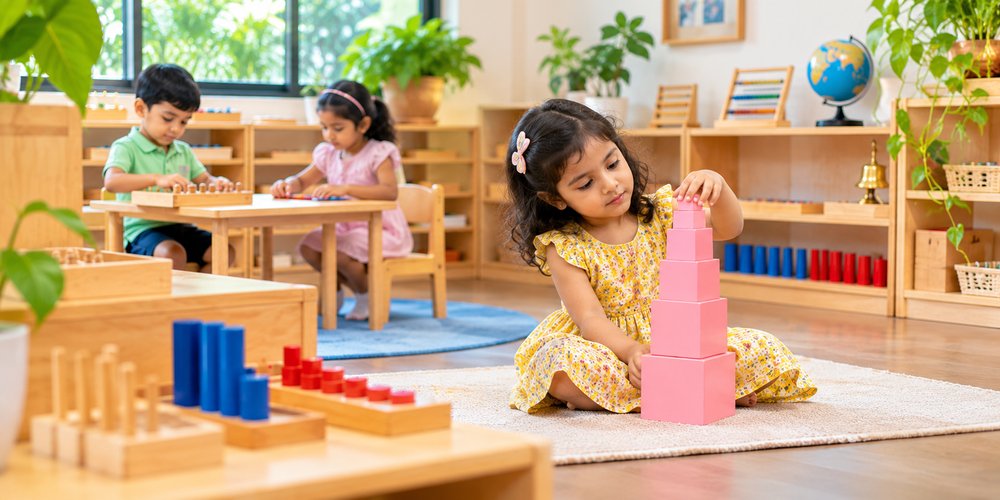
A classroom with wooden materials, low shelves and neatly arranged activity corners may look like Montessori, but those features alone do not tell the whole story. Some schools follow the Montessori method closely, while others use selected materials alongside teacher-led lessons, worksheets and conventional preschool routines. The difference lies in what happens throughout the day: how teachers guide children, how activities are introduced, how much uninterrupted work time children receive and whether the environment genuinely encourages independence.
Age is another question families often have while choosing an early learning programme. Many parents ask what is the best age to start Montessori, and children commonly enter a Montessori primary environment around age 2.5 to 3, depending on readiness and the school’s approach. However, readiness, independence and the school’s approach matter more than a particular birthday. These seven signs can help parents look beyond the brochure and assess what a Montessori school actually offers.
1. Sign 1: Authentic Montessori Method (Not Just Name)
The best Montessori schools in Bangalore should demonstrate more than Montessori-themed materials or classroom décor. A genuine Montessori programme is grounded in Dr. Maria Montessori’s developmental principles rather than relying on standard curriculum worksheets.
Classrooms typically have a structured work cycle in which children are given meaningful choices within a carefully prepared environment. Teachers observe the children and introduce materials or lessons when appropriate, rather than directing every activity. The uninterrupted work period gives children time to concentrate, practise skills and explore concepts at their own pace.
2. Sign 2: Prepared Environment (Child-Centric Design)
A Montessori classroom is designed around children’s size, needs and growing independence. Low shelves, child-height tables and accessible materials allow children to reach what they need without constantly asking an adult for help.
The room is usually organised into areas covering practical life, sensorial activities, language and mathematics. Children can select materials, use them and return them to their proper place. Simple routines like these give children regular opportunities to practise responsibility and independence.
3. Sign 3: Montessori-Trained Teachers
The teacher’s role looks different in a Montessori classroom. Rather than standing at the front and leading the entire group through the same activity, the teacher observes individual children and responds to their development and readiness.
Montessori-trained educators introduce lessons, demonstrate how materials are used and provide guidance when needed. They may work with a child individually or with a small group, allowing children to progress through activities without turning every lesson into a whole-class exercise.
4. Sign 4: Hands-On Learning Materials
Montessori classrooms use specialised materials rather than relying mainly on generic plastic toys or commercial workbooks. The materials give children concrete ways to explore ideas that might otherwise be difficult to understand.
Many are designed to provide feedback through their use, allowing children to notice mistakes and make corrections with less adult intervention. Activities can support coordination and concentration while helping children develop a clearer understanding of mathematical, language and sensorial concepts.
5. Sign 5: Mixed-Age Classrooms
Many Montessori primary environments bring children together across several years, often around ages 2.5 to 6, depending on the school’s structure.
A younger child may learn by watching an older child work, while an older child gets an opportunity to reinforce their own learning by helping someone else. Children therefore experience cooperation, peer learning and leadership as part of their everyday classroom life rather than as separate activities.
6. Sign 6: Recognition & Authenticity
Membership or affiliation with an established body such as the Indian Montessori Centre can give parents another source of information about a school’s Montessori approach. During admission for kindergarten, parents can check whether a school has relevant affiliations and understand what those affiliations represent.
An affiliation certificate should not be the only factor in the decision. A classroom visit can reveal much more. Look at the materials available, how teachers interact with children, how much uninterrupted work time is provided and whether children are encouraged to work independently.
7. Sign 7: Focus on Holistic Development
Early education involves more than learning to read, write or count. A Montessori environment also gives children opportunities to develop social confidence, independence, coordination and practical problem-solving skills.
For children who later move into elementary Montessori schools in Bangalore, these habits can support the transition to the next stage of learning. The emphasis remains on helping children become increasingly capable of managing tasks, making appropriate choices and working with others.
When exploring options for the best nursery schools in Bangalore, the classroom itself deserves close attention. At Bright Kid Mont, parents can use these criteria to understand the learning environment, from the classroom setup and teacher involvement to the opportunities children have to make choices, practise skills and take responsibility for their work.