Why Investing in a Playschool Franchise in India Is the Smartest Business Move
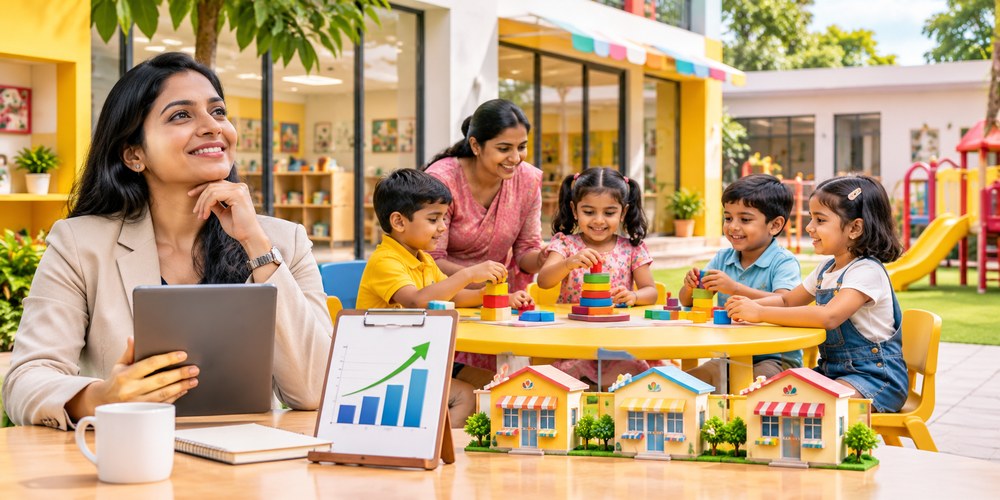
Education holds up better than most sectors through economic cycles. Parents keep spending on their children’s earliest years even when other budgets tighten, which gives early education unusually steady demand.
India’s preschool market has expanded quickly over the past decade, and a playschool franchise lets you enter it without building everything yourself. For many first-time owners, this is the wisest way in.
The Growing Demand for Playschool Franchises in India
The forces behind the growth are clear enough. Nuclear families are now the norm, and with both parents often working, structured childcare has become a necessity rather than a choice. Early education has moved from optional to essential in most urban households.
The demand reaches well beyond the metros too, with Tier 2 cities catching up quickly. Increasingly, parents want a genuine learning environment for their little ones, not simply a place to leave them for the day.
A Proven Business Model
Starting a preschool alone means learning every lesson through trial and error. A franchise removes most of that burden.
You begin with a ready curriculum and tested operating procedures from the first day. Established systems save years of guesswork. The risk of failure falls sharply compared to an independent setup, since the model has already succeeded elsewhere.
The launch timeline is shorter too, because the groundwork is complete. That advantage is a large part of what draws newcomers to a profitable play school franchise in India.
Strong Brand Recognition
Parents place their trust in names they know, particularly with something as precious as their child. A recognised brand carries that trust forward, so enrolments begin from the first intake rather than months later. Marketing support is usually built in as well, which means an owner is not left hoping families notice the centre on their own.
Low Investment, High ROI Potential
A playschool needs far less capital than most businesses with comparable earning power, and the revenue side is sound too.
Typical investment varies widely by brand and model. Fixed-package franchises generally require a larger upfront commitment, while flexible models let you match the package to your locality. In return, income flows from several directions:
- Admission fees at the start of each cycle
- Monthly tuition, paid steadily through the year
- Daycare and activity programmes that add further revenue
That spread of income keeps a centre financially steady rather than dependent on a single source. What matters as much as the entry cost is the recurring one: a royalty of a few percentage points compounds against you for the life of the agreement, which is why the model you choose matters as much as the decision to franchise.
Recurring Revenue and Business Stability
Few businesses enjoy income this predictable. Annual admission cycles bring a fresh intake each year, so revenue is planned rather than merely hoped for. Unlike retail or hospitality, a preschool is not seasonal; families rely on it every month, throughout the year. That consistent, repeating demand gives owners a stability many other sectors would envy.
Scalability: Build Multiple Centres
Real growth follows once the first centre runs well. The table below shows how the journey typically unfolds.
| Stage | Focus | Outcome |
| First centre | Establish, stabilise, build reputation | Proof the model works locally |
| Second centre | Replicate proven systems | Faster launch, shared learning |
| Multiple centres | Scale across areas or cities | Long-term business growth |
Because the model is designed to be repeated, expanding from one location to several is far simpler than launching each from scratch. A brand that already runs some of the best play schools in Bangalore can carry those same systems into a new city with little friction. For owners with ambition, that scalability turns a single school into a genuine enterprise over time.
Key Factors to Consider Before Choosing a Franchise
Not every brand deserves your investment, so weigh a few things carefully before signing. Study the brand reputation closely, since it drives those early enrolments. Examine the curriculum quality, because parents can tell the difference.
Compare the investment against realistic ROI rather than the headline promise. Assess the location’s potential, and test how dependable the support system truly is. Anyone researching how to get a school franchise in India should treat these five as non-negotiable.
Conclusion
A playschool franchise offers a rare combination of steady demand, predictable income, low risk and room to grow. It suits first-time owners and seasoned entrepreneurs alike, precisely because so much of the hard groundwork is already done.
Whether you are considering your home city or a fresh market such as a playschool franchise in Hyderabad, weigh the brand, the curriculum, the numbers and the support before you commit. Anyone researching how to get a school franchise in India should also check the royalty structure, since it affects returns for as long as the agreement runs.
Bright Kid Mont is built for that kind of growth. Partners choose a package sized to their first location, keep every rupee they collect, and can open a second centre on the same curriculum, training and systems once the first is running.